This morning we had a workshop on how to conduct a workshop. It ended up being more like an open lecture/discussion with input from all participants. Main outcome: There is no other way learning how to do a good workshop than doing a workshop. One nice book-resource many people may not know (at least i didn't ;)
"The Idea Agent" by Jonas Michanek and Andréas Breiler...There is also a homepage about it here
Showing posts with label methods. Show all posts
2013/02/26
2013/01/01
itaú: transformative transactions
The last project before i started with my master thesis was an individual project in cooperation with the biggest south-american bank, Itaú. The brief asked us to think about the future of banking. We could choose our own focus almost unrestrictedly. That led to a very diverse range of great results in our class.
I decided to work on the aspect of shared living expenses. It was a choice based on personal experiences, but I received feedback from countless people that supported my ideas.
Here is the result in form of an animation and the abstract.
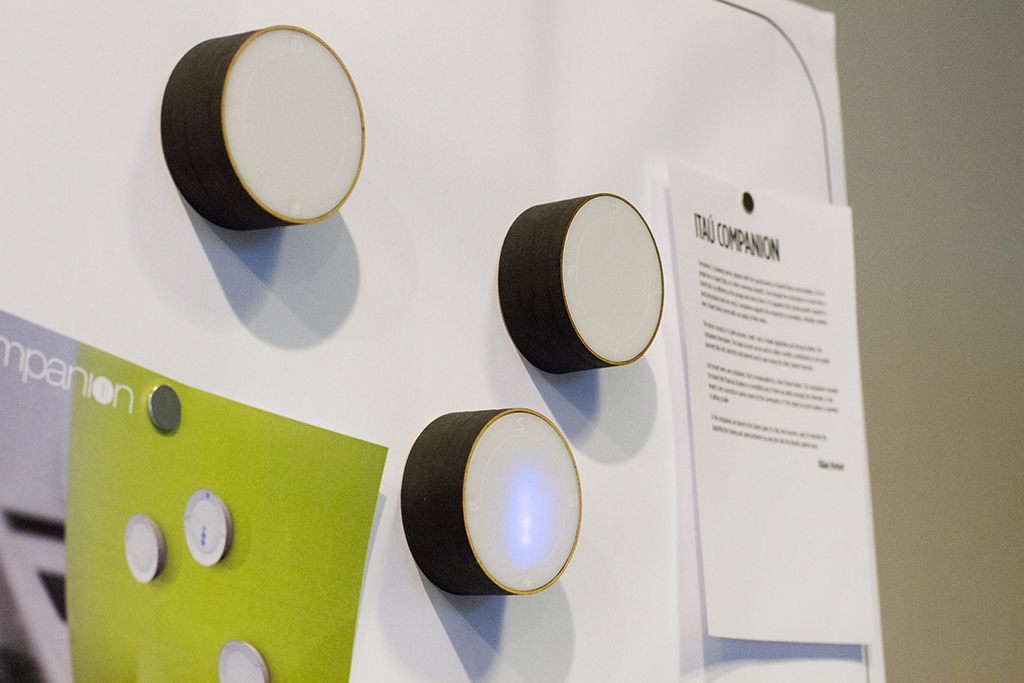
"Companion is a banking service aligned with the special needs of shared living communities.
A lot of people live in shared flats as it offers numerous benefits. Even though the motivation to move into a shared flat is as different as the people who live in them, it is apparent that sharing goods supports a good atmosphere and vice versa. Companion supports this reciprocity by providing a flexible solution every shared living community can adapt to their needs.
The service consists of a bank-account, a web- and a mobile application and physical tokens, the companions themselves. The bank account can be used to collect monthly contributions to do regular payments like rent, electricity and internet and to save money for other shared expenses.
Each tenant owns one companion, that is recognizable by a color
chosen before. The companions visualize the shared flats financial situation in a simplified way: If there are debts amongst the flatmates, if one tenant is very successful in saving money for the community or if the shared accounts balance is growing or getting smaller.
As the companions are placed in the shared space of a flat, they become a part of everyday life, supporting the sharing and saving behavior by using the rules the tenants agreed upon."
I got a lot of insights from a workshop i conducted at UID. 12 people from the Interaction-, Advanced Product- and Transportation Design program shared their ideas and experiences they had on my project.
One personal goal I set for myself was building an experiential prototype that is as close as possible to the final products physical appearance. Using an Arduino Mini Pro, the TexasInstruments TLC5940 LED driver and an "optimized" breadboard layout made it possible to achieve that goal.
The prototype was part of an exhibition at school. The next step would have been fitting the technical components into the product design i did for the project.
2012/05/02
2 great tools for mac
I started to use two tools which dramatically increased my productivity. That's a good thing to work with so many different people, there is almost no day you do not learn something - even if it is only a super simple tool.
#1 - "TotalFinder" - It simply adds Tabs to the Mac OS finder and makes it a lot more convenient to use multiple finder windows..or tabs..whatever. It also adds a Dual-window feature to the finder, something I really like about working with Windows 7.
#2 - "iAWriter" - A tool to create text. Not more, not less. And that's exactly what I love about it - no danger of procrastinating in choosing fonts or playing around with grids and layout. Just text.
2012/04/24
Language as participation
As we are pretty busy with our current project I don't really get round to write on my blog. Still I wanted to share some insights from our current process. We are doing a service-design project on the topic of "Language as participation"
We spent the first two weeks doing intense design-ethnography. The whole class conducted interviews around the topic of language learning. Our interviewees were students, immigrants, refugees, teachers, language and dialect specialists..Our focus was to find out about how learning works in everyday life's situations and encounters. We mapped out our interviewees "journeys" of learning or teaching foreign languages (mostly Swedish) and started to analyse the material in a number of synthesis sessions.
In a two-day workshop we draw conclusions by creating posters on which we mapped the most important themes in language learning. For instance, cross-generational learning plays a big role in a lot of people's life's: It happens as soon as kids, their parents and maybe their grandparents speak different languages natively and by that learn from each other. Sometimes there are two native languages (from mother and father) plus their shared language (often English) plus an additional language of the country the family lives in involved.
After splitting up in smaller groups of two - three students, we started to think about focus areas. I teamed up with my classmates Adam (Swedish) and Jules (Dutch) as we shared the interest in the different learning channels. There are different types of learners: auditive, visual, kinesthetic and tactile learners. Most people learn the most effective by having an individual mix of learning methods, probably with a focus on one of them. That's when we started to ask ourselves what would happen if you take away the access to one learning channel? If born deaf the auditive channel is very limited or even not available. We started to look into the topic of Sign-language and decided to focus on it for the rest of the project.
In one more week we explored a lot about the topic, read a lot of articles, papers and stories from deaf people as well as relatives and experts.
We prepared a workshop with our class, our tutors and teachers to get ideas from people who have no or only little knowledge about the topic and approach it completely un-biased.
Yesterday we started a number of interviews with people who are in touch with Sign-language: educators, speech therapists, interpreters, users of Sign-languages. It is an extremely interesting but very challenging topic at the same time. For now, we have no idea what we could come up with, as there is still a lot to learn and to narrow down. One thing we decided though: We will do a service for parents who rear a deaf kid and have to learn Sign-language because of that.
2012/02/06
Voices of Umeå
The week before the last we had a short project together with a local composer. He is planning to make a music-piece made up from human voices. Our brief was to give him the tool to collect those voices. It should be some sort of installation in public space, that makes people to record their voice.
Our idea was to use the iconic shape of an old telephone as it is an unmistakable hint that one can 'talk to it'. Providing two telephones, people could have a conversation over a short distance. The rotary dial is used to apply different effects on the voice and by that invite people to experiment with their voices.
In further development, a sampler functionality could be used to enable the user to create music with his own voice - fun project, and a nice introduction into sound design, which we will work on during the next couple of weeks...
2012/01/12
Police Command & Communication Center - research
The project started with a introductory visit to the Command and Communication Center (CCC) in Umeå. Being a rather small center it is still representative for a pretty modern working environment.
In a couple of sessions we conducted an extensive research by shadowing and interviewing the so called "dispatchers".
The working stations of the dispatchers contain tons of equipment: radio, telephone paper work and, most important for us, a PC workstation with an interface on 3-5 widescreen monitors. The dispatchers workload reaches from idle time to extremely stressful peaks were they have to handle multiple tasks at once (some former dispatchers now work as fighter jet pilots).
Of many hundred applicants a year only about three to four are suitable for the job. Mostly women.

The first challenge was to understand the whole system of emergency calls, managing ressources and dispatching patrols. It is a very complex system witch even more complex decision-making processes.
We got a deep insight on as the police officers patiently explained almost every detail. We had the chance to visit the CCC a couple of times, so we were able to build on a well-founded knowledge.
After the first week of research, the class of 11 students split up in three groups based on different opportunity areas.
I decided to team up with Siri, Ayse and Shelagh to work on the area we called "cooperative environment". We saw big potential in taking the whole CCC as a system to improve not only focusing on the screens itself.
Analyzing the interaction workflow was important to understand the interface and all peripherals in detail. The analysis revealed many opportunities and potentials for improvements, as shown later.
One excerpt of our analysis: The interaction flow during the case of a hit reindeer (which is super-kliché but very common in northern sweden) As you see, the dispatcher has to go crazy in the interface, as he needs to switch between three monitors all the time. This means turning the head a lot of times, and travelling (literally) meters with the cursor.
In a couple of sessions we conducted an extensive research by shadowing and interviewing the so called "dispatchers".
The working stations of the dispatchers contain tons of equipment: radio, telephone paper work and, most important for us, a PC workstation with an interface on 3-5 widescreen monitors. The dispatchers workload reaches from idle time to extremely stressful peaks were they have to handle multiple tasks at once (some former dispatchers now work as fighter jet pilots).
Of many hundred applicants a year only about three to four are suitable for the job. Mostly women.

The first challenge was to understand the whole system of emergency calls, managing ressources and dispatching patrols. It is a very complex system witch even more complex decision-making processes.
We got a deep insight on as the police officers patiently explained almost every detail. We had the chance to visit the CCC a couple of times, so we were able to build on a well-founded knowledge.
After the first week of research, the class of 11 students split up in three groups based on different opportunity areas.
I decided to team up with Siri, Ayse and Shelagh to work on the area we called "cooperative environment". We saw big potential in taking the whole CCC as a system to improve not only focusing on the screens itself.
Analyzing the interaction workflow was important to understand the interface and all peripherals in detail. The analysis revealed many opportunities and potentials for improvements, as shown later.
One excerpt of our analysis: The interaction flow during the case of a hit reindeer (which is super-kliché but very common in northern sweden) As you see, the dispatcher has to go crazy in the interface, as he needs to switch between three monitors all the time. This means turning the head a lot of times, and travelling (literally) meters with the cursor.
Police Command & Communication Center - ideation workshop
After two weeks of research we developed two rough paper prototypes. Both were quite different to what the dispatchers are used to and we were pretty curious to test their reactions.
In a one-day workshop, in which police-officers and dispatchers participated, we tested the low-fi prototypes by playing through a quick scenario with them. We learned a lot of useful lessons, some of them were quite surprising, as many of the subjects were most familiar with some of the more radical approaches.
I had the opportunity to learn a lot about quick prototyping and early-stage user testing, which was one of the most important steps in the whole project.

As our group also addressed the whole room as an opportunity area, we asked the officers and dispatchers to show us how they like to work. We gave them a toolkit of desks, projection areas etc. to play with. By that we found out, that today's room layout is almost the opposite of what the people working in it want to have.
After the workshop we perused all the feedback and worked out a more detailed concept. We went through many iterations of wireframes like you see on the left, refining them more and more every step.
In a one-day workshop, in which police-officers and dispatchers participated, we tested the low-fi prototypes by playing through a quick scenario with them. We learned a lot of useful lessons, some of them were quite surprising, as many of the subjects were most familiar with some of the more radical approaches.
I had the opportunity to learn a lot about quick prototyping and early-stage user testing, which was one of the most important steps in the whole project.
As our group also addressed the whole room as an opportunity area, we asked the officers and dispatchers to show us how they like to work. We gave them a toolkit of desks, projection areas etc. to play with. By that we found out, that today's room layout is almost the opposite of what the people working in it want to have.
After the workshop we perused all the feedback and worked out a more detailed concept. We went through many iterations of wireframes like you see on the left, refining them more and more every step.
Police Command & Communication Center - final demo & user testing
For the second workshop we built a back projected prototype to come as closest to the final experience as possible.
We would have loved to have a fully interactive prototype, but that was impossible to do in that short period of time (10 days between workshop 1 and 2).
We prepared a case we played through with the police-guys: First we gave a 5 minute introduction to our interface followed by a crime event we simulated and the officers / dispatchers had react to on the interface.
The result was mind-blowing, as all of the subjects were able to conduct all tasks without any mistakes at the first attempt. Considering the fact, that the old system needs weeks to get familiar with, this was a big success.
The feedback on our approach of using a touchscreen paired with a special keyboard and a special communication device was really good. The concept improved workflow as well as ergonomics and provided a more compelling experience of use.
We would have loved to have a fully interactive prototype, but that was impossible to do in that short period of time (10 days between workshop 1 and 2).
We prepared a case we played through with the police-guys: First we gave a 5 minute introduction to our interface followed by a crime event we simulated and the officers / dispatchers had react to on the interface.
The result was mind-blowing, as all of the subjects were able to conduct all tasks without any mistakes at the first attempt. Considering the fact, that the old system needs weeks to get familiar with, this was a big success.
The feedback on our approach of using a touchscreen paired with a special keyboard and a special communication device was really good. The concept improved workflow as well as ergonomics and provided a more compelling experience of use.
2011/10/28
graphic design_2
2011/10/23
portraits
Finished our photography week. Did not expect such a high level as none of us is a professional.
Next step will be to translate the photos to a poster related to that person
2011/10/21
paper emotions
Task: Communicate one out of nine different given emotions with cut-out pieces of black paper.
This one is fear.
This one is fear.
2011/10/17
portraits
Crash-course on portrait photography this week. One of my classmates shared a link to a documentation on Annie Leibovitz - probably one of the most famous photographers of our days...quite inspiring!
--> see the video here.
so cliché :)
Legobrick ideation! Love it :) I don't want to tell too much - it's on a exhibition we will have in about 4 weeks...
2011/10/15
reflect!
After studying 5 weeks at UID, we did a reflection on it ( In the IxD programme we reflect A LOT! ) What to keep, what to tweak...Actually the tweaks predominated :) Seems we are a pretty critical class! Good thing, though.
2011/10/14
how to crash a euro-palette with a forklift
There was a presentation of a one week workshop about car-security at UID today. One of the groups built a full-scale model of a car cockpit - with a camera projecting content to the field of view. Impressive!
The whole workshop was a collaboration of all the 2nd year master students at UID. That meant, that transportation designers, product designers and interaction designers grouped and worked on different concepts for 5 days.
After working on a few car related projects in the past, some of the stuff was not totally new and mind-blowing, but there were some really interesting approaches, that will be discovered in following projects at UID.
I passed by the project room from time to time, and it seemed to be great fun...Some guys attached a car seat on a manual forklift and crashed it against a europallete to see what happens...They used a human dummy (he was actually missing at the presentation :) )
2011/09/30
A crocodile in New York City
The last assignment for the week: Everyone of us got a picture and a Lego Minifigure as a 'user' ( we were allowed to keep it, YAY! ). We had to think on how our 'user' could benefit from a networked city and come up with some ideas on that. I had a crocodile in New York City.
2011/09/28
nursing home grandparent - at a restaurant - proximity
After the mapping exercise we did a fun brainstorm on service design: Divided in groups of 2-3 students, we received a set of cards in three colors. The task was to group one of every color, while pink was a user, orange was a location and green was a particular kind of sensor. We spend brainstorming for a couple of minutes to come up with a service idea for every group of cards. Then we decided for one favorite idea to present it in the form of a stage play...
Our words were: 'recent immigrant' + 'at the bank' + 'GPS sensor' ... Matt did a movie of every groups play - i hope they will NEVER come to light...
It was a very interesting way to come up with tons of ideas in a very short time - and it was great fun :)
Our words were: 'recent immigrant' + 'at the bank' + 'GPS sensor' ... Matt did a movie of every groups play - i hope they will NEVER come to light...
It was a very interesting way to come up with tons of ideas in a very short time - and it was great fun :)
mapping a social network
Next morning, very nice results from all my classmates - all with totally different materials, approaches, solutions...Just some words on my work: I chose to use an old keyboard as material, as it stands for me as the main way of interacting in a social network. We had to map different characteristics in our model, so i raised the keys one millimeter per friend i have beginning with a particular letter ( M won! ) The return key is raised by the number of status messages i posted since I started using facebook (green stands for 2009, yellow for 2010, pink for 2011)
Afterwards i have to say, i should have chosen different materials, as I was always afraid of trying out things ( i only had one keyboard to use ) I think a better approach is, just use stuff like toothpicks and do a lot of trials ( and errors! ) see the results of all of my classmates here.
2011/09/23
Tinkering as PhD thesis. Great.
In our weekly literature circle ( great thing btw - I finally get to read a lot more ) the UID PhD researcher Camille Moussette did show some of his work on haptical sketching. Amazing stuff. He is working on thoughts how tactile feedback can be communicated. or so :) See his homepage and his blog for more tinkering.
2011/09/18
Just a thought on interviewing technique
In our discussions during the week we talked a lot about how our interviews went. There are so many things you can do wrong.
An interesting idea i need to try at some point would be to do an interview in a group of three - the questions go to two people who answer to it. This could lead to a lot more answers, as interviewees often act shy and reserved being in an interviewing situation. In addition, one of the interviewees could be a member of the team, acting as a motor for the conversation.
Subscribe to:
Posts (Atom)